Semen analysis, in plain words
Your report is a set of numbers. Not a verdict.
Every value on a semen analysis explained the way a good doctor would explain it: what it measures, where it sits among fertile men, and what guidelines say happens next.
Built from the WHO 2021 laboratory manual and the AUA/ASRM and EAU guidelines. Every claim links to its source. Nothing here recommends a treatment or a supplement.
Picture 100 sperm as 100 little men
WHO 2021 lower reference limit for concentration. One in twenty fertile men was below it; the median was 66.[1]
Average time from the start of sperm production to ejaculation, measured directly. Today's test reflects the past two to three months.[2]
Guidelines ask for at least two analyses, about a month apart, before anyone draws conclusions from an abnormal result.[3]
The three numbers people search for at 2 a.m.
Each parameter, explained from the evidence up
Where do my numbers sit?
Place your values on the WHO 2021 reference range
The reference population is about 3,500 men whose partners conceived naturally within 12 months. This box describes where a value falls among them. It does not predict your chances and it is not a diagnosis. Nothing you type leaves your browser.
What guidelines say happens next
The path after an abnormal result is more orderly than the internet suggests
Repeat the test
At least two analyses, ideally a month apart, with the same abstinence length and a complete collection. Within-man variation for sperm count is about 50%, so one result is a snapshot, not a trend.[3][4]
Examination and, if needed, blood tests
A physical exam checks for a varicocele. Hormone tests (FSH, testosterone) are indicated when the count is low; genetic tests enter below 5 million/mL. Isolated low morphology on its own rarely triggers either.[3][5]
A plan based on the whole picture
Guidelines weigh all parameters together, with total motile sperm count doing most of the work, alongside the partner's evaluation and how long you have been trying. No single number decides the route.[3]
Shorts
Thirty seconds per number
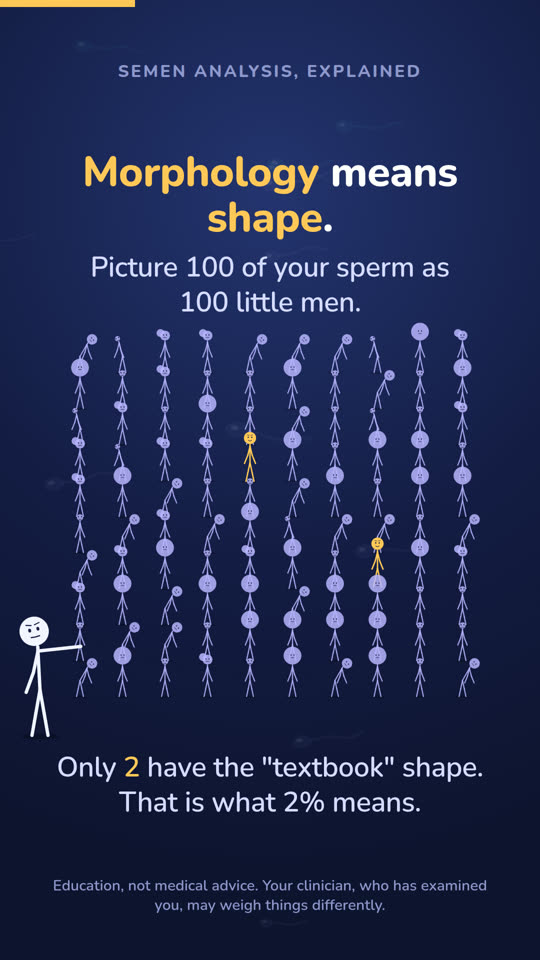 Morphology 2%: what it really meansShort 01 · Morphology
Before your appointment
Get the one-page doctor-visit checklist
The eight questions that turn a confusing report into a useful conversation, plus a note when a new explainer is published. No supplements, no sales, unsubscribe any time.
Sources on this page
- WHO 6th-edition reference distributions (Campbell et al., 2021), reproduced in PMC. https://pmc.ncbi.nlm.nih.gov/articles/PMC12539902/table/t1/
- Misell LM et al. Human spermatogenesis kinetics in vivo. J Urol 2006. https://pubmed.ncbi.nlm.nih.gov/16406920/
- AUA/ASRM Guideline on the Diagnosis and Treatment of Infertility in Men (2024 amendment). https://www.auanet.org/guidelines-and-quality/guidelines/male-infertility
- Keel BA. Within- and between-subject variation in semen parameters. Fertil Steril 2006. https://pubmed.ncbi.nlm.nih.gov/16412742/
- EAU Guidelines on Sexual and Reproductive Health: Male Infertility. https://uroweb.org/guidelines/sexual-and-reproductive-health/chapter/male-infertility